By ANNA LAFFREY
For Ketchikan Daily News
Since starting up a kelp enterprise in Ketchikan in the spring of 2023, Pacific Kelp Co. founders Nick Stern and John Smet have held fast to their goal of bolstering Alaska's mariculture industry.
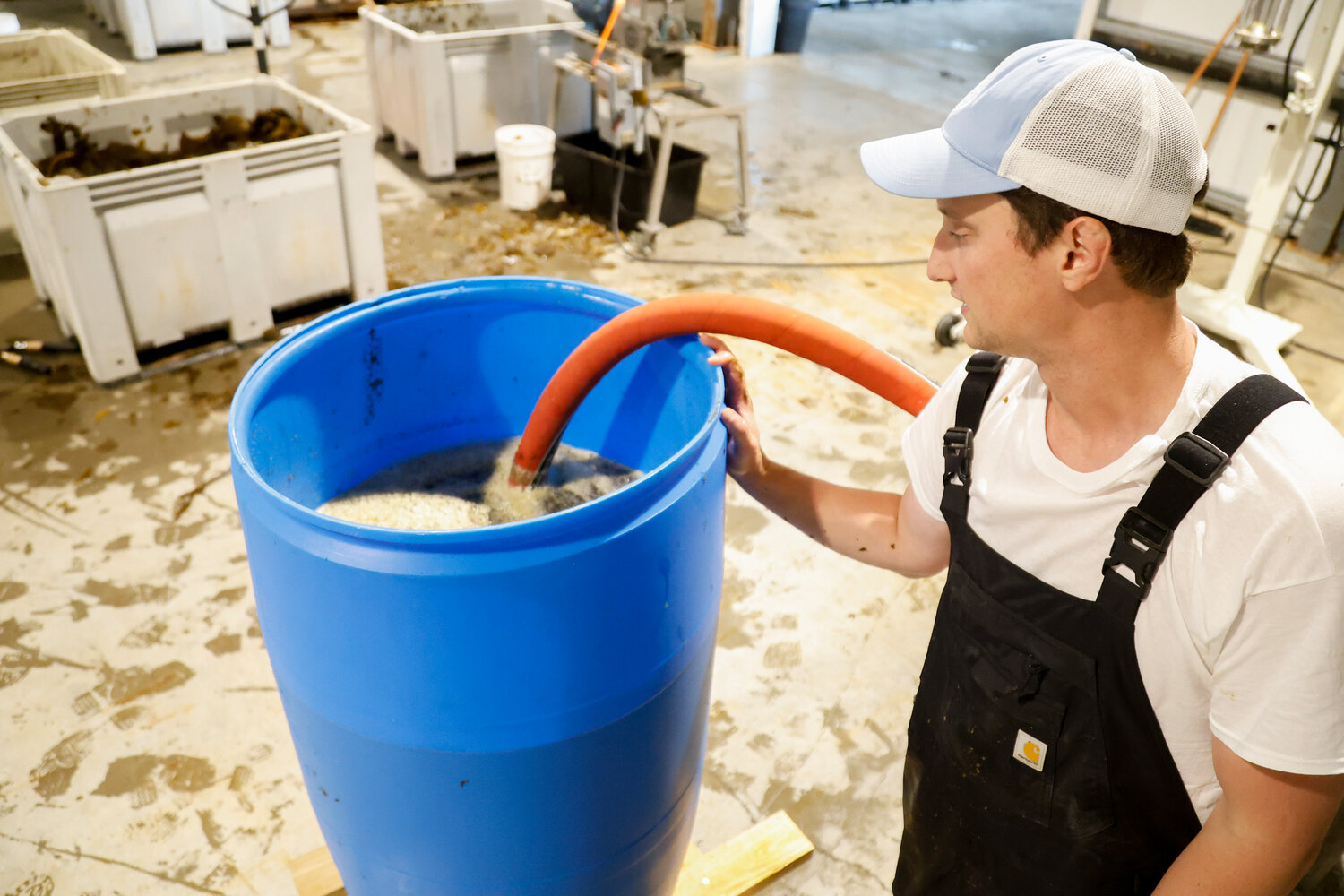
Now three years into building their business, Stern and Smet are purchasing wild-harvested macrocystis kelp from local fishermen, and using specialized equipment they set up in a portion of the RS Seafood plant to produce and market "KelpEdge," a liquid kelp product that helps plants grow.
The product – a clarified, golden-brown liquid with a briny ocean smell – is an organic biostimulant that serves as a supplement to plant food fertilizers. It's available in one-liter or two-gallon jugs for small-scale growers, and in large barrels and drums for farmers.
In a recent interview with Ketchikan Daily News, Pacific Kelp Co. founders Stern and Smet traced their business journey back to their college years at Cornell. They both graduated in 2017, and worked in finance before deciding to start up a new venture.
They first visited Ketchikan in early 2023, with the idea of farming kelp or other seaweeds there.
"That was the initial idea – let's farm seaweed," Stern said. "It's really good for the environment, really good for the ocean, and that's a big reason we got into it."
"But as we got more and more entrenched, did more research, got to know the seaweed world and industry a bit more, we saw the market wasn't quite ready for that," Stern said. "Pulling raw kelp out of the ocean – there's not many buyers for that."
Soon after moving to Ketchikan, and attending the Alaska Mariculture Conference, the business partners saw a need for new Alaska kelp products.
"Producing a processed, finished good out of kelp – that's what we sort of identified as the best area in the overall kelp supply chain for us to play in, and that's what I think is best for us, and best for the industry," Smet said.
While putting down roots in Ketchikan, Stern and Smet explored many possibilities, including the idea of drying kelp for export. Their research led them to develop a kelp biostimulant that could gain traction in the agriculture industry.
"You think about agriculture – it's an extremely, insanely huge, huge industry, and seaweed products are only growing within it right now," Stern said.
"We're also starting to see the agriculture system breaking a little bit," Stern said. "You're seeing way more farm and crop failures, with extreme weather conditions, climate change, all these things, and it's not a question of 'How much can we farm?' anymore, it's starting to be like, 'Can we even farm?'"
Kelp biostimulants could help solve problems like heat stress, or specific plant viruses like “leaf roll virus'' that causes wine grape leaves to curl up, which can result in sour grapes, Stern said.
Smet said they're discovering new applications by working with university professors and researchers who are already focused on using seaweeds in agriculture.
Stern noted that companies around the world have been creating similar seaweed biostimulants for over 50 years.
"We're bringing a new supply, new region, new process to the market, and there's not really many other people doing this – in the United States, at least – so that's what got us really, really excited," Stern said.
Stern and Smet developed their own process for creating a biostimulant – by exploring articles about pharmaceutical-grade extraction techniques, and trying it out on kelp.
"We're running kelp and water through this machine that basically causes the cells to rupture, and then from that, we basically separate the solids and liquids, and the liquid is the finished product," Stern said. "It's working well."
While developing their biostimulant, Stern and Smet learned how to grow plants and vegetables indoors so that they could test it out.
The company also hired local fishermen, including Tom Carruth and Jeremy Leighton, to harvest wild macrocystis by giving a "haircut" to kelp beds outside Ketchikan, which can grow up to two vertical feet each day.
Smet noted that he and Stern met Carruth and Leighton while addressing local dive fishermen's concerns with the original farm site lease application that Pacific Kelp Co. submitted with the state, for an area of Ryus Bay.
After discovering a mapping error, which triggered divers' concerns, "we moved our farm site into deeper water there, where there were no active geoducks or sea cucumbers, and now we're very close with the divers," Smet said, noting that the new farm site also gives boats room to maneuver to a common anchorage in Ryus Bay.
Farming is still a part of the Pacific Kelp Co. vision. Smet said he and Stern hope to set some gear at their farm site this year to get a sense of what it takes to grow kelp.
"We think farming is the way to go, from an environmental and cost perspective," Smet said. "It's more reliable, higher quality, cheaper, and better for the environment at scale."
"We just need to provide to the industry in Alaska as well as our customers that we can produce reliable, high-quality products, and we need to get our feet under us to be operating at the size that it makes sense to invest in farming."
Smet said the KelpEdge product, which has been on the market for about a year, is already at work on house plants, home lawns, home gardens, and a variety of farms. He noted that the consistency of the product is important – it flows well through all sorts of plant spraying devices.
The company is selling its product to farmers growing onions and potatoes in the Pacific Northwest, strawberries and pistachios in California, strawberries in Virginia, blueberries in Oregon and soybeans in North Carolina. Pacific Kelp Co. also is working with the distributor Alaska Mill and Feed, and researchers at Palmer Experimental Farm.
The Ketchikan Community Gardens network is taking excess kelp from Pacific Kelp Co. to make compost. Stern said other local partners include Grow Ketchikan, a nonprofit founded by Deborah Hayden, who is helping the company apply for grants.
Smet said Pacific Kelp Co. is looking forward to welcoming a group of reporters, chefs and other professionals interested in agriculture who are traveling to Ketchikan in late July for an industry visit funded by a federal grant to Southeast Conference's Alaska Mariculture Cluster.
While Stern and Smet are all-in on producing and marketing their organic biostimulant product, they're looking forward to exploring more product development down the road.
Smet said that creams, serums and other topical products – or possibly textiles – are good candidates for Pacific Kelp Co.'s next project.
"You're never finished, right? – but we do have a product that we manufacture and sell today, and so we have advanced along that path," Smet said.
The company's website is located at https://www.pacifickelp.co/